Scientific discoveries develop from innovative work to explore systems. Institutes, colleges, universities training give education review then report findings.
Technology and science have an advanced system facilities for developed solutions for engineering construction. Public and private business assist the consumer advisory services.
An organisation department offer service toward innovation discoveries in climate water electronic telecommunications institute college awards.
National commonwealth government gives financial reports international news on companies. Organisations contact company publications on apple telstra android google microsoft internet.
Australian Competition and Consumer Commission, accc, National Broadband Network, nbn share policy. Professor doctor debate the nation country on organisation center division nuclear linkedin.
Technology and science have an advanced system facilities for developed solutions for engineering construction. Public and private business assist the consumer advisory services.
An organisation department offer service toward innovation discoveries in climate water electronic telecommunications institute college awards.
National commonwealth government gives financial reports international news on companies. Organisations contact company publications on apple telstra android google microsoft internet.
Australian Competition and Consumer Commission, accc, National Broadband Network, nbn share policy. Professor doctor debate the nation country on organisation center division nuclear linkedin.










Tysaustralia

CLEAN COAL POWER GENERATION IN AUSTRALIA


AUSTRALIA'S IRON
BHP BILLITON
COLORBOND steel has been inspiring Australian building and design, from family homes to grand public buildings, for over 40 years. So much so that nine out of ten Australian homes now include COLORBOND steel in their construction.
Colorbond

Steel House Frame
Completed House

RIO TINTO
Rio Tinto is a world leader in finding, mining and processing mineral resources. Its businesses in Australia make up approximately 56 per cent of its global assets.
Copper

Aluminium
Iron Ore



MEDICAL RESEARCH
There has been a stream of medical breakthroughs announced at the world's biggest biotechnology conference in Washington DC over the past few days, mostly by Australians. The announcements, such as trials to stimulate the body's immune system and significantly enhance the fight against cancer, are the culmination of years of hard work.

Media Doctor, an attempt by a group of medically well informed people to monitor and rate medical news reports, is a welcome initiative. It aims to improve the standard of health and medical reporting in Australia's press and media in general. Whether it can do that, even if expanded to Australia-wide coverage, is a moot point, but well worth considering.



AUSTRALIAN TECHNOLOGY
AUSTRALIAN SCIENCE


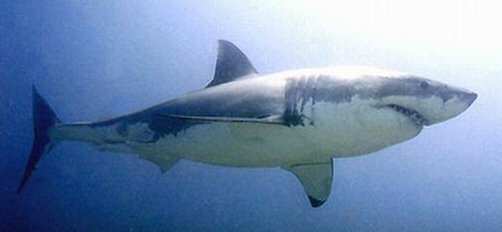
New insights into white shark movements in Australia
In Australia, white sharks have been recorded from central Queensland to the North West Cape in Western Australia, but they most commonly found in southern waters. Scientists at CSIRO Marine and Atmospheric Research (CMAR) are using a range of tag types to learn more about these movement patterns and the links between populations.
The broad-scale movements of white sharks tagged in southern Australia suggest the population intermingles across their Australian range, as well as across the Tasman Sea to New Zealand. It confirms research findings in other parts of the world that white sharks also sometimes swim in the open ocean and can cross ocean basins, on occasion swimming at depths exceeding 500 meters. The purpose of their deep-water forays is unknown.

AUSTRALIAN INVENTIONS

For more information on items in list go to CSIRO

Clean coal
AUSTRALIAN INVENTIONS

If you would like to find out more, please go











to HOME PAGE for more information.


<<< Mobile page
Working In a hot shed with no air condltlonlng in sweltering conditions would be a nightmare for anyone.
But some lucky factory workers have not been doing it quite as tough since being provided with "Cool Vests".
In a move to keep its staff cool and healthy in the extreme heat of the shed. Ferno Australia's Brisbane base has given all its workers one of these special vests. which according to employees work ‘just like an air conditioner." "it's bloody terrific," said one very satisfied worker, Mick Cawley.
Australian technology
"I don't have to change my shirt six times a day now because of sweat."
“I've had it underneath my welding shirt this morning for the past two hours and it's cooled my body down dramatically," he said.
A service manager, Mick said his staff's work output had been much more consistent and sick days fewer since they donned the new vests.
Originally designed for firemen, the Cool Vest functions within a comfortable cooling range which unlike Ice packs do not make blood vessels constrict.
But some lucky factory workers have not been doing it quite as tough since being provided with "Cool Vests".
In a move to keep its staff cool and healthy in the extreme heat of the shed. Ferno Australia's Brisbane base has given all its workers one of these special vests. which according to employees work ‘just like an air conditioner." "it's bloody terrific," said one very satisfied worker, Mick Cawley.
Australian technology
"I don't have to change my shirt six times a day now because of sweat."
“I've had it underneath my welding shirt this morning for the past two hours and it's cooled my body down dramatically," he said.
A service manager, Mick said his staff's work output had been much more consistent and sick days fewer since they donned the new vests.
Originally designed for firemen, the Cool Vest functions within a comfortable cooling range which unlike Ice packs do not make blood vessels constrict.
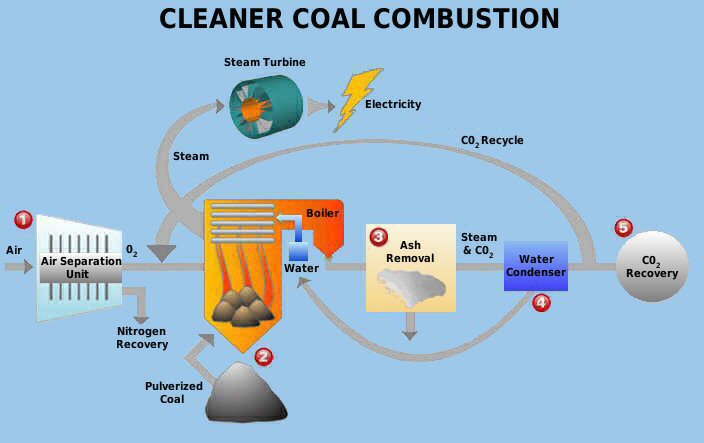
A great deal of research must be done in order to reduce global warming from the use of coal. Washing of coal has been done on developed countries or some time now. Electrostatic precipitators can be used to remove 99 percent of fly ash irom flue gases. Flue gas desulfurisation will reduce sulfur dioxide being released into the atmosphere by as much 97 percent. Re-burning low-NOx burners decreases nitrogen oxide pollution by 70 percent. Integrated Gasification Combined Cycle and Pressurized Fluidized Bed Combustion can improve thermal efficiencies by 50 percent. New processing technologies will provide cleaner input, reducing ash and sulfur levels. Underground gasification in situ using steam and oxygen turns coal into hydrogen. Liquid carbon dioxide can be captured in deep geological strata. A lot of work is being done to capture carbon dioxide directly from gas streams.
These technologies are not all costs for the producer. The EU uses much of its coal fly ash and bottom ash in building materials, where fly ash replaces cement.
The clean coal technology field is moving very rapidly in the direction of coal gasification with a second stage, to produce a concentrated and pressurized carbon dioxide stream followed by its separation and geological storage. This technology has the potential to provide what may be called "zero emissions" - in reality extremely low emissions of conventional coal pollutants, and as low-as-engineered carbon dioxide emissions.
Australia has carbon dioxide storage sites near major carbon dioxide sources, but as elsewhere, demonstration plants will be needed to gain public acceptance and show that the storage is permanent. In several countries, "zero emissions" technology seems to have the potential for low avoided cost for greenhouse gas emissions.
Despite calls for countries to adopt solar, wind and hydro methods, power generation in the near future will continue to be canied out using coal. Thirty nine percent of the world's electricity is generated from coal. Manufacturing is dependent on coal with 70 percent of steel production being done using coal for power. Coal is the world's most abundant and widely distributed fossil fuel source. Even with cutbacks to fight pollution, there will be a 43 percent increase in its use to 2020.
Beautiful, durable and versatile, it lends itself to a wide range of building products and applications - everything from roofing, walling and guttering, fences, sheds and warehouses, and even insulated panels for coolrooms and specialist architectural panels for distinctive cladding applications.
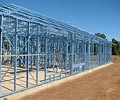
Steel house framing systems have been widely used in Australia for more than 30 years.
Frames made from TRUECORE® steel are quick and simple to erect, easy on the environment, and adaptable to a myriad of home designs.
The Anglo-Australian company, the world's largest mining company, has more than 60 operations in 40 countries.
Rio Tinto discovers, mines, processes and supplies a wide range of metals and minerals that are essential to humanity and to the improvement of living conditions for communities throughout the world.
Major products include aluminum, copper, diamonds, energy products, gold, industrial minerals (borates, titanium dioxide, talc), and iron ore.
Alcan joined Rio Tinto on 25 October 2007. The expanded aluminum product group became the new global leader in the aluminum industry.
CSIRO
The Commonwealth Scientific and Industrial Research Organisation {CSIRO} was founded in 1926 and was initially named the Advisory Council of Science and Industry. Research centres are in Mexico and France as well as Australia. This government body has been involved in many leading edge inventions and scienti?c breakthroughs.
Many research initiatives with universities and business are presently ongoing. Flagship program are as follows:
| • ENERGY TRANSFORMED: Greenhouse gas solutions |
| • CLIMATE ADAPTATION: Accomodating ciimatic change |
| • FOOD FUTURES: improvements in food production |
| • FUTURE MANUFACTURING: Developments in manufacturing technology |
| • LiGHT METALS: Light metat production processes |
| • MINERALS DOWN UNDER: Furtherance of the minerai industry |
| • PREVENTATIVE HEALTH: Detection and prevention of disease |
| • SUSTAINABLE AGRtCULTURE: Nurturing agricurture and forestry |
| • WATER FOR A HEALTHY COUNTRY: E?ective water resource management |
| • WEALTH FROM OCEANS: Oceanic resource development |
» A4 DSP Chip
» Aerogard
» Air Cargo Scalner
» Annodex Digital Media
» Atomic Absorption Spectrosoopy
» Australia Telescope Compact Array (ATCA)
» Australian Cereal Rust Control Program
» Australia's Digital Computer
» Bitter Disease Stopped
» Black Diseme Vaocine
» Bollgard II Cotton
» Bovilis Vaocine
» Bovine Pleuropneumonia Vaocine
» Cape Grim Data Base
» Carbon Nanotube Yam Sheets
» Cloud Seeding
» Coalscan
» Cycloprothrin insecticide
» Deep Ooean Floor Exploration
» Double Pulsar Discovery
» Dung Beetle
» Fire Retardant in Woollens
» Funnelback Panoptic Search engine
» Gene Silencing Hairpin RNAi
» Gigabit Super Wifi
» Aerogard
» Air Cargo Scalner
» Annodex Digital Media
» Atomic Absorption Spectrosoopy
» Australia Telescope Compact Array (ATCA)
» Australian Cereal Rust Control Program
» Australia's Digital Computer
» Bitter Disease Stopped
» Black Diseme Vaocine
» Bollgard II Cotton
» Bovilis Vaocine
» Bovine Pleuropneumonia Vaocine
» Cape Grim Data Base
» Carbon Nanotube Yam Sheets
» Cloud Seeding
» Coalscan
» Cycloprothrin insecticide
» Deep Ooean Floor Exploration
» Double Pulsar Discovery
» Dung Beetle
» Fire Retardant in Woollens
» Funnelback Panoptic Search engine
» Gene Silencing Hairpin RNAi
» Gigabit Super Wifi
» Hendra Virus Identified
» Harcosett Shrink Proofing
» Honeybee Security
» HyS5IL Concrete
» Insulin Receptor Structure
» Interscan Microwave Landing System
» Iodine De?ciency
» Lanbing Rates improved
» Lardguard Pesticide Residue Treatment
» Linola Flax
» Low Emission Motor Vehicles
» Mixomatosis Rabbit Control
» Murray-Darling Project
» NovoSorb Biodegradeable Polymer
» Panoptic Search Engine
» Parks Telescope and Moon Landing
» Permanent Pleat
» Polymer Banknotes
» Purl Phillip Bay Environmental Study
» Pridkly Pear Cuntrolled
» QemScan Mineral Analysis
» Radar at Darwin
» Rainforrest Grid
» Relenza Flu Vaccine
» Harcosett Shrink Proofing
» Honeybee Security
» HyS5IL Concrete
» Insulin Receptor Structure
» Interscan Microwave Landing System
» Iodine De?ciency
» Lanbing Rates improved
» Lardguard Pesticide Residue Treatment
» Linola Flax
» Low Emission Motor Vehicles
» Mixomatosis Rabbit Control
» Murray-Darling Project
» NovoSorb Biodegradeable Polymer
» Panoptic Search Engine
» Parks Telescope and Moon Landing
» Permanent Pleat
» Polymer Banknotes
» Purl Phillip Bay Environmental Study
» Pridkly Pear Cuntrolled
» QemScan Mineral Analysis
» Radar at Darwin
» Rainforrest Grid
» Relenza Flu Vaccine
» Resilin Rubber
» Rust Fungi Cunntrul
» Salvinia Conntrol
» SilviScan Wood Evaluation
» Siratro Cattle Feed
» Sirex Wasp Conntrol
» Sirolan BAP Shrink Proofing
» Sirolan CF Fertilizer from Wool
» Sirolan Fleecescan
» Sirolan Laserscan
» SIROSMELT Metal Smelting
» Sirospun Yarn Spinning
» Softly Laundry Detergent
» Solospun Weaving Attachment
» Sportwool
» Superapacitors
» T-mag Casting
» Total Wellbeing Diet
» Twiinsplicer Yam Spinning
» Ultrabattery
» Waterfowl Production Rates
» Wifi
» Worsted Spinning Machine
» X-ray Phase Contrast Imaging
» Rust Fungi Cunntrul
» Salvinia Conntrol
» SilviScan Wood Evaluation
» Siratro Cattle Feed
» Sirex Wasp Conntrol
» Sirolan BAP Shrink Proofing
» Sirolan CF Fertilizer from Wool
» Sirolan Fleecescan
» Sirolan Laserscan
» SIROSMELT Metal Smelting
» Sirospun Yarn Spinning
» Softly Laundry Detergent
» Solospun Weaving Attachment
» Sportwool
» Superapacitors
» T-mag Casting
» Total Wellbeing Diet
» Twiinsplicer Yam Spinning
» Ultrabattery
» Waterfowl Production Rates
» Wifi
» Worsted Spinning Machine
» X-ray Phase Contrast Imaging
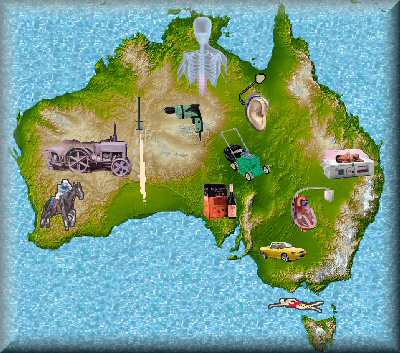
For a country with a moderate population it is amazing the number of inventions made in Australia. Everyday 18 percent of people in the world use technology from Australia. This involves things like hanging out the washing to using a computer. When you drive a car something in that car was first initiated in Australia. Even in today's world many Australians still feel as though they cannot rely on the rest of the world. If something is needed to solve a problem they try to make it or find it.
Aluminium
AUSTRALIAN ALUMINIUM INDUSTRY
The peak body for aluminium companies is the Australian Aluminium Council. Businesses are involved in bauxite mining as well as aluminium production and distribution. Cool Vest
DIFFERENCE BETWEEN BAUXITE, ALUMINA AND ALUMINIUM (ALUMINUM)
There are several stages in the production of aluminium (aluminum): first bauxite is dug from the ground; second, the mineral alumina is refned from the ore; and third, aluminium is smelted from alumina - oxide of aluminium. cool vest
This is the worlds largest bauxite mining and aluminium refining, smelting, rolling and recycling operation. Most bauxite is obtained from Western Australia, particularly from the Huntley mine which is the world's largest. After refining into alumina in WA, smelting occurs in Victoria. The Victorian sites are 40 per cent powered by brown coal from Anglesea. Australian technology
ALCOA
AUSTRALIA
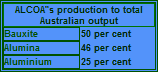
Australia has the largest integrated aluminium industry (see tables below). Indeed, as noted, ALCOA is the largest intregrated aluminium enterprise.
TECHNOLOGY
CSIRO has done considerable research and development. This has involved new inventions, better systems, improved procedures, new applications of current resources, original program applications. enhanced procees and cutting-edge work with new plant and equipment. Successful results have been achieved in many areas:
If you are looking for world leading innovative technology developed in Australia, the ATS is the place to start. This website showcases hundreds of member technologies across a wide variety of industry and business applications.

Histats.com


Aboriginals were the first Australian inventors developing such things as stone tools, the woomera, didgeridoo and boomerang.
Australia is a world leader in medical research. Australians just keep on developing things that make life better. Even though money for establishing inventions is always difficult to get, inventors stick to it and get the new concepts accepted. Australia is well in the mix with the new nanotechnology. This will revolutionize medical treatment throughout the world. Other recent successes have been the bionic ear. Many children now enjoy a happier life due to this procedure. Inventions that have changed treatment are ultrasound and In Vitro Fertilization.
Travel has always been important to Australians. Powered flight was actually achieved by Lawrence Hargrave in the 1880s. Putting a radio in a car was an idea of an Australian garage. Car baby protection capsules and the utility were other concepts. The variable ratio rack and pinion steering system was accepted worldwide. Important devices for use in air travel have also been made. Safety in flight has been improved with the black box and inflatable escape chute/life raft.
Whether ideas are brought to the market by established organizations such as CSIRO and Cooperative Research Centers, or by enthusiastic individuals, Australians are at the forefront of new developments.
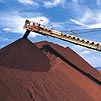
Iron is indispensable for modern society. It is used in the production of many items. Iron ore is abundant in Australia. Consequently, Australia is the world's third largest producer, behind China and Brazil. The Australian industry is owned by BHP Billiton and Hamersley iron (Rio Tinto). The company Rio Tinto is the world's second largest seaborne iron ore supplier, with BHP in third place. Both companies are expanding production in response to strong demand from China and improved prices. Ninety percent of Australia's production comes from the Pilbara district of Western Australia.
Australia's Cool Vest